Pitfall Avoidance Guide for Mortar Sprayer Selection in Rockery Construction
With the rapid development of cultural tourism landscapes and landscape engineering, the demand for mortar spraying equipment in rockery construction has been steadily increasing. Many practitioners often encounter issues such as low construction efficiency, poor quality, and financial losses when selecting equipment due to insufficient understanding of pump specifications and project compatibility. This article provides a scientific analysis of the selection criteria for mortar spraying machines based on industry standards and practical operating conditions, offering actionable guidance for rockery construction projects.
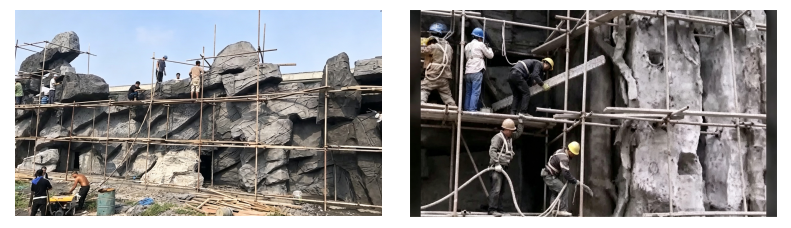
Job
First, it must be clarified that mortar spraying machines are primarily classified into three types based on their pump structure: screw-type, piston-type (plunger-type), and extrusion-type. Considering the actual working conditions and industry practices in rockery construction, the screw pump is the predominant choice, while other pump types exhibit significant limitations.
Piston pumps exhibit noticeable pulsations during discharge, which can lead to mortar segregation and uneven spray surfaces; therefore, they are only suitable for specific operating conditions. Extrusion pumps are exclusively appropriate for lightweight mortars without coarse aggregates, whereas the mortar used in rockery construction typically contains aggregates and high viscosity, rendering its performance entirely inadequate for construction requirements. In contrast, screw pumps, with their continuous and stable discharge characteristics, enable the formation of smooth and uniform mortar surfaces, perfectly meeting the critical spray quality demands of rockery construction. Consequently, they remain the preferred pump type for this application.
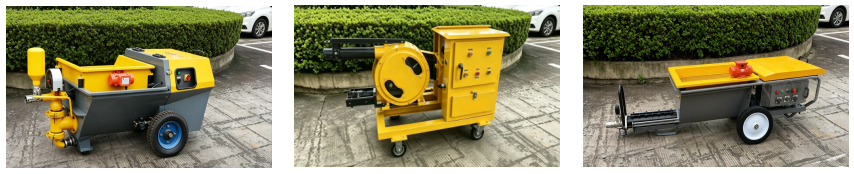
piston squeege screw
When selecting among the wide variety of screw-type mortar pumps available in the domestic market, the following key parameters should be prioritized: first, rotor pitch and eccentricity value—each one-unit increase in pitch raises pressure by approximately 0.6 MPa, while greater eccentricity yields higher displacement; these parameters must be matched according to the complexity of the rockery design and construction scale.Second, the drive system should prioritize either the German NORD variable-speed motor or a domestically produced variable-frequency motor of equivalent power, ensuring stable pressure while accommodating diverse mortar pumping requirements. Third, for hopper capacity, large-scale projects recommend using capacities exceeding 50L to minimize disruptions to construction continuity caused by frequent material loading. Fourth, the configuration of wear-prone components requires confirmation of the wear-resistant materials for both rotors and stators to prevent project delays due to excessive wear.
Based on the scale and construction requirements of rockery projects, appropriate pump models can be selected scientifically according to project categories: For Class I, II, and III large and medium-sized projects (e.g., large rockeries in urban parks, commercial complexes, and cultural tourism attractions), which involve high construction heights, substantial mortar consumption, and stringent pressure and discharge demands, the Wen Gong GP110 or GP90 screw pumps are recommended—comparable to the German SEEPEX 2L4 and 2D8 models—with discharge capacities of 5–8 m3/h, enabling efficient large-area spraying operations. For Class IV small-scale projects (e.g., private residences and small landscape rockeries), characterized by limited construction areas and reduced mortar usage, the Wen Gong GP70, GP60, or GP50 lightweight models are suitable—similar to the SEEPEX 2L54,2L6, and 2L88 models—with discharge capacities of 2–4 m3/h, offering flexibility and portability to meet the spraying requirements for small rockery designs.
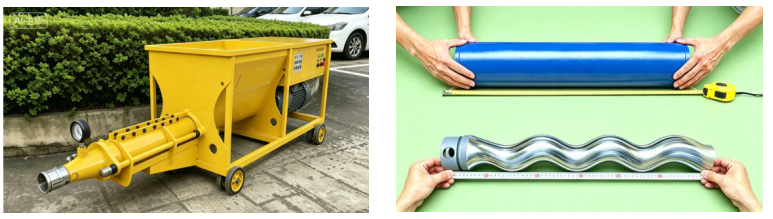
GP110 screw Large pitch
Additionally, the following pitfalls should be avoided during equipment selection: refrain from using small equipment for large-scale projects, as this can lead to pump overload and accelerated stator wear, compromising spray quality and significantly reducing the equipments service life.
In summary, the key to selecting a rockery construction mortar spraying machine lies in "matching the right equipment to specific requirements." A comprehensive assessment of the project scale and mortar properties is essential. Prioritizing the selection of a screw pump and parameters suitable for the operational conditions ensures construction quality while reducing equipment wear, improving efficiency, and avoiding project delays and financial losses caused by improper equipment selection.
(For more information, please refer to the relevant materials.)
Written by Xiao Qi